
 |
TravelSmart.NET
Archive Home |
|
Inquirer.NET
Home |
|
TravelSmart.NET
Home |
| Hotels |
|
| Resorts |
|
| Car
Rental |
|
| Shuttle
Service |

Text and photos
by Angelina G. Goloy
 A FORMER PRISON seems an unlikely tourist attraction,
yet Alcatraz is one of the most visited spots in the United States,
thanks partly to history and largely to Hollywood. Most tourists,
particularly non-Americans, know about the former federal penitentiary
built on an island near San Francisco from films like ''The Birdman
of Alcatraz,'' ''Papillon,'' Escape from Alcatraz'' and ''The
Rock.''
A FORMER PRISON seems an unlikely tourist attraction,
yet Alcatraz is one of the most visited spots in the United States,
thanks partly to history and largely to Hollywood. Most tourists,
particularly non-Americans, know about the former federal penitentiary
built on an island near San Francisco from films like ''The Birdman
of Alcatraz,'' ''Papillon,'' Escape from Alcatraz'' and ''The
Rock.''
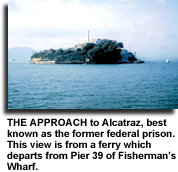 Closed because of rising maintenance costs in 1963
after 29 years as a federal penitentiary, Alcatraz was reopened
in 1973, not for prisoners, but for visitors who would want to
know more about its history and experience its surroundings.
Closed because of rising maintenance costs in 1963
after 29 years as a federal penitentiary, Alcatraz was reopened
in 1973, not for prisoners, but for visitors who would want to
know more about its history and experience its surroundings.
Now part of the Golden Gate National Recreation Area, it annually receives about a million visitors, who are transported there exclusively by Blue & Gold Fleet ferries from Pier 39 of Fisherman's Wharf to join tours conducted by the National Park Service.
For our group of visiting Asian journalists, Cathay Pacific and the San Francisco Convention and Visitors Bureau arranged one such tour--and more, compliments of our guide, National Park Ranger John Cantwell.
For nearly three hours, he walked us not only through the regular stops, but also through precarious pathways on the edge of the rocky cliffs, steep, narrow stairways that led to passages known only to prison guards, an underground access, padlocked gates that squeaked--mostly areas off-limits to the public.
Some parts roused a sense of adventure. Others conjured up in us eerie thoughts of being the only persons on the island and that at any moment, the park ranger would mysteriously strut out of sight, leaving us to find our way back to the here and now. For a little suspense, he would occasionally feign confusion as to which direction was the exit, or deliberately fumble with the keys.
Reassuring, though, was the walk on the roof of the cellhouse which had some of the best panoramic views of San Francisco and its famed bridge. But to the inmates, Cantwell said, it was the ultimate torture. Freedom seemed so near, yet so far.
The thrill of being on Alcatraz comes both from an awareness of its historical significance as well as filmmakers' fascination with it. During our tour, Cantwell made sure he sustained his listeners' interest by weaving movie references into his talk about the island's history.
''Remember that explosion scene in 'The Rock'? That was shot here,'' he said as we gathered in the damp, decaying power generation room, one of our first stops. He claimed to have been assigned to show the cast and crew around. ''In fact, Sean (Connery) and I hit if off quite well. We were like this,'' he quipped, winking as he brushed together the forefinger and middle finger of his right hand. Quite a raconteur, he.
Crossing over one of the sealed trap doors, he led us to a gate that opened to one of the workshop buildings which also used to house the laundry room. He pointed to a smaller workshop building closer to the edge of the island, saying it was the scene of four of the 14 escape attempts, including one by Clint Eastwood's character, in ''Escape from Alcatraz.''
Escaping meant doing a Dustin Hoffman in ''Papillon'' jumping into the bay and swimming a mile and a quarter to San Francisco--if one could survive the icy waters and strong currents, that is.
 Did anyone succeed? It cannot be ascertained. According
to a brochure published by the Golden Gate National Parks Association,
of the 36 men who tried to escape, five were never seen or heard
from again and are presumed to have drowned. The rest were either
shot or recaptured, like the prisoner who survived the swim to
the city, but was near death when guards caught up with him on
the rocks below the Golden Gate Bridge.
Did anyone succeed? It cannot be ascertained. According
to a brochure published by the Golden Gate National Parks Association,
of the 36 men who tried to escape, five were never seen or heard
from again and are presumed to have drowned. The rest were either
shot or recaptured, like the prisoner who survived the swim to
the city, but was near death when guards caught up with him on
the rocks below the Golden Gate Bridge.
Material culled by Hollywood from the island's history is often reworked for cinematic effect. For example, we were told, Burt Lancaster's ''birdman'' character was based on a real prisoner, Robert Stroud, who did have pet canaries--not on Alcatraz but at the federal penitentiary in Leavenworth, Kansas. His real nickname was ''Bird Doctor of Leavenworth.''
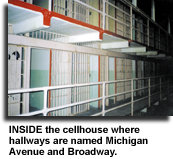
To make our Alcatraz experience complete, Cantwell took us inside the cellhouse and locked us up for a few minutes. Our chaperone, Laurie Arrmstrong, chose to stay outside and record our incarceration with our cameras.
''Listen to the clanging of the steel bars as the doors slide and slam shut,'' he said as he walked over to the end of the hallway to maneuver a system of levers that open and close the cell doors. ''To the inmates, it was the sound of doom and desperation.''
Walking past our cells, he suggested that we look around the unit, which measured five by nine feet wide and seven feet high. It had a sink, a toilet, a small table, a folding seat attached to the cement wall and no window. Prisoners were provided a steel-framed bed with a thin mattress.
The cell was small and cold, with absolutely no privacy. Still, I thought, for the prisoners cramped in damp, stinking jails back home, this would be high living.
Alcatraz was never filled to capacity. It had 336 cells, but the average number of prisoners it held was 260. A total of 1,545 convicts declared ''incorrigible'' did time there, among them the notorious Al Capone. The average number of years a prisoner stayed there was 8 to 10 years, or until he was no longer considered incorrigible.
In response to a query from our mostly female group, Cantwell said no women were ever jailed on the island because they were not declared incorrigible until 1969, six years after Alcatraz was closed.
Although it is best known for the federal penitentiary, Alcatraz was originally the site of a military fort and the first lighthouse on the Pacific Coast (still operated to this day). It was also a prison for soldiers convicted of crimes during the American Civil War, as well as Indians captured during the Indian wars and military convicts during the Spanish-American War.
And long before it harbored society's outcasts, the 22-acre (8.8-hectare) sandstone peak was a haven for birds. So much so that Spanish explorers who landed there in the 1700s gave it a name derived from a Spanish word meaning birds, specifically pelicans.
No animals that might prey on the birds could survive on the few shrubs that the rocky sandstone ground, thin soil, and salt-laden cold wind allowed to grow.
During the construction of the fort and the lighthouse in the mid-1800s, rocks blasted from the island settled on the shoreline, providing homes for marine animals. Also, along with the topsoil brought in to cushion gun platforms came seeds of California plants. In time the military, inmate gardeners, and families of soldiers and prison officials planted flowers, vegetables, and trees.
Today Alcatraz is considered an ecological preserve,
home to one of the largest western gull colonies on the northern
California coast and frequented by hawks, ravens, geese, hummingbirds--and,
yes, humans drawn by a curiosity whetted by history with a little
help from Hollywood.

| See related story: |
| Student draws up plan for a 'wall-less prison' |
