|
|
 |
|
DIVING
IN PARADISE
DIMAKYA
ISLAND
This island,
where Club Paradise is located, is blessed
with beautiful coral reefs within it's immediate vicinity. On the west
side of the island, right in front of the lounge is a reef which
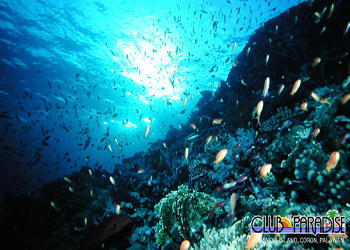
is a beautiful coral garden. The reef features soft and hard corals
in an explosion of colors, amazingly tame reef fish, and untold surprises
(occasional greetings by two huge Mantas in three meters of water in
this very reef ). Right in the middle of this confusion of color is
a clearing with white sand at three meters of water. This is the site
we call "The Classroom", indeed a very ideal place to teach Scuba-Diving.
On the
steep slope, which runs down to seventeen (17) meters, there are lots
of sponges, Tunicates and Sea Squirts, Garupas, Parrot Fish and the
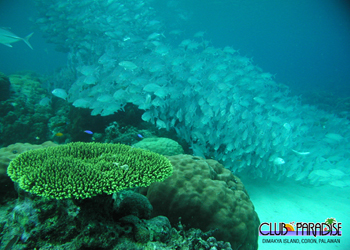
occasional family of Bumpheads (the largest measures approximately 1.7
meters). On
the far end of the reef exists an extensive garden of Staghorn corals
populated by Rainbow Runners, a school of Barracudas and Goat Fish.
A special treat awaits the diver at a small nook at thirteen (13) meters
near "The Classroom" --- the chance to see a rare Giant Clam (Tridacna
Gigas), measuring around one meter. On the
north side of the island is a sloping reef. The corals are not as colorful
as in "The Classroom" but the chances of seeing Mantas, Eagle Rays,
and Marine Turtles are greater in this area. Lobsters and a great assortment
of reef fishes call this place home.
CROSSING
This reef
is a naturally submerged bridge between Dimakya Island and "Islang Walang
Lang-aw". The reef is about two to three kilometers long. This
reef can account for three to four dive spots and each dive spot can
be a different experience for the diver. The main distinguishing characteristic
of this spot is it is literally overran with with Acropora (Table top
and other branching corals.) A huge Green Sea Turtle is occasionally
seen in this area. The top of the reef is at eighteen (18) meters.
This side
of the island faces the open sea and such chances of seeing Pelagic
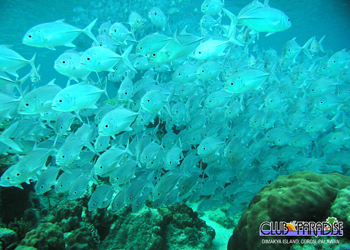
Fish are greater. On one particular dive, schools of Tunas, Jacks, and
a Manta were seen at the same time. |
 |
 |
 |
BARRY'S
REEF
This elongated
submerged reef is located in a cove which is about twenty minutes away
from the Club. The top of the reef is at three to four meters and the
slope sharply drops to twenty-seven meters
(27) meters. There are plenty of macro subjects on this reef: amusing
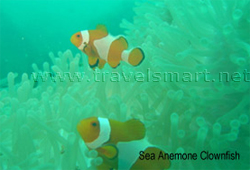
Spanish Dancers, juvenile Spotted Sweetlips, large Anemones with African
Common and Pink Shunk Clown Fishes communally live with Blue Banded
Anemone Shrimps. In about eighteen (18) meters, there is one large Cabbage
Coral approximately 2.5 meters in diameter and at twenty-five (25) meters,
there lives an Acropora whose diameter is roughly 2.3 meters. The formations
of small to medium-sized Porties is unusual in that they form some sort
of a big stairway.
DIBUYAN
West
This dive
spot is off an island which is roughly about fifteen (15) minutes away
from the Club. The top of the reef is at thirteen (13) meters and the
sides slope down to twenty-eight (28) meters. Medium-sized coral formations
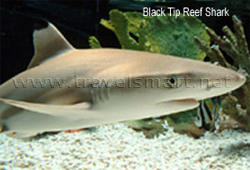
exist on this site. Medium-to-large-sized White Tip, Black Tip, and
Grey Tip Sharks are often sighted here. A large school of Surgeonfish
and Batfish are consistently sighted here. Mantas show up occasionally.
DIMALANTA
SHIPWRECK
The
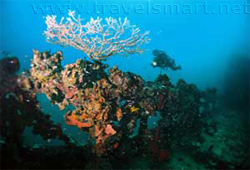
only one in Busuanga, the wreck can be reached by a forty-minute (40)
boat ride from Club Paradise. An awesome sight to behold, the ship lies
in about forty-five (45) meters of water, but it is divable since it
lies upright and the deck is at twenty-seven (27) meters.
Although
this cargo ship was cleverly camouflaged as a small island, it did not
escape the assault of the US forces of Admiral Halsey during the World
War II. Legend has it that the captain of the Kyokuzan, fearing the
onslaught, chose to separate her from the rest of the fleet in a desperate
attempt to save the cargo. On that fateful day of September 24, 1944,
the Kyokuzan Maru sank in the depths of Northern Palawan waters.
Today,
divers may experience the eerie yet interesting cargo hold of the Kyokuzan
which houses a wartime Toyota Lexus, the only one of its kind in the
world, a giant barracuda which lurks in the deep and a giant grouper
the size of a Volkswagen beetle. |
|
|
 |
ISLANG WALANG LANG-AW
South
The name
literally translated in English means "Island With No Trees". The islet
is located on the East side of Club Paradise just ten minutes away by
boat. There is an extensive "hump" coral formations on a shallow, gently
sloping terrain. The reef starts at three meters and ends at around
twenty-five meters. White and Black Tip Sharks are regularly seen, with
an occasional sighting of Mantas and Eagle Rays.
East
On the
back side of the island, the side facing away from the Club, there is
a good opportunity for Macro
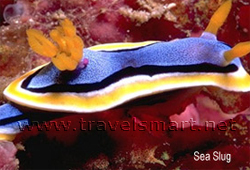
Photography. The place is inhabited by innumerable species of Nudibranchs,
small reef fish, Moray Eels, and lots of corals. There have also been
occasional sightings of a school of six (6) large Eagle Rays measuring
from 1.5 to 2 meters or more. Marine Turtles also inhabit this area
since the island is a nesting ground.
ISLANG
WALANG TAO
North
This short
but beautiful reef can can be reached by a fifteen-minute boat ride
from the resort. The island's
name in English means the "ISLAND WITHOUT PEOPLE". The reef gently slopes
down to eighteen meters, and is home to one 1.5 meter long Black Tip
Shark, and on occasions, a two-meter Nurse Shark patrolling the area.
The Elephant Ear Sponges here are large and so are the Cabbage Corals.
Plenty of small reef fish inhabit the area, not to mention one or two
medium-sized Napoleon Wrasses and an occasional school of large Bumpheads.
It is also in this area that divers sometimes see a school of six large
Eagle Rays, probably the same school that hangs around the "Islang Walang
Lang-aw" which is only about two kilometers away from this dive spot.
South
On the
other side of the island is a reef that is mainly flat. On some points,
the reef slopes on a ten to twenty degree angle. In one particular point,
ledges can be seen, a natural stairway; and it is on these ledges that
White Tip Reef Sharks are seen lounging around as if sunbathing. There
are large formations of the dangerous but beautiful fire corals here.
|
Club Paradise Home | Accommodation/Island Map | Coron Island Map | Diving
Facilities | Calauit Island Wilde Park | Dugong | Waters Sport | Yachting | Wiki Map
Home | Palawan Home | Club Paradise Wiki | Hotels | Resorts | Flights | Land Transportation | Contact Us |